
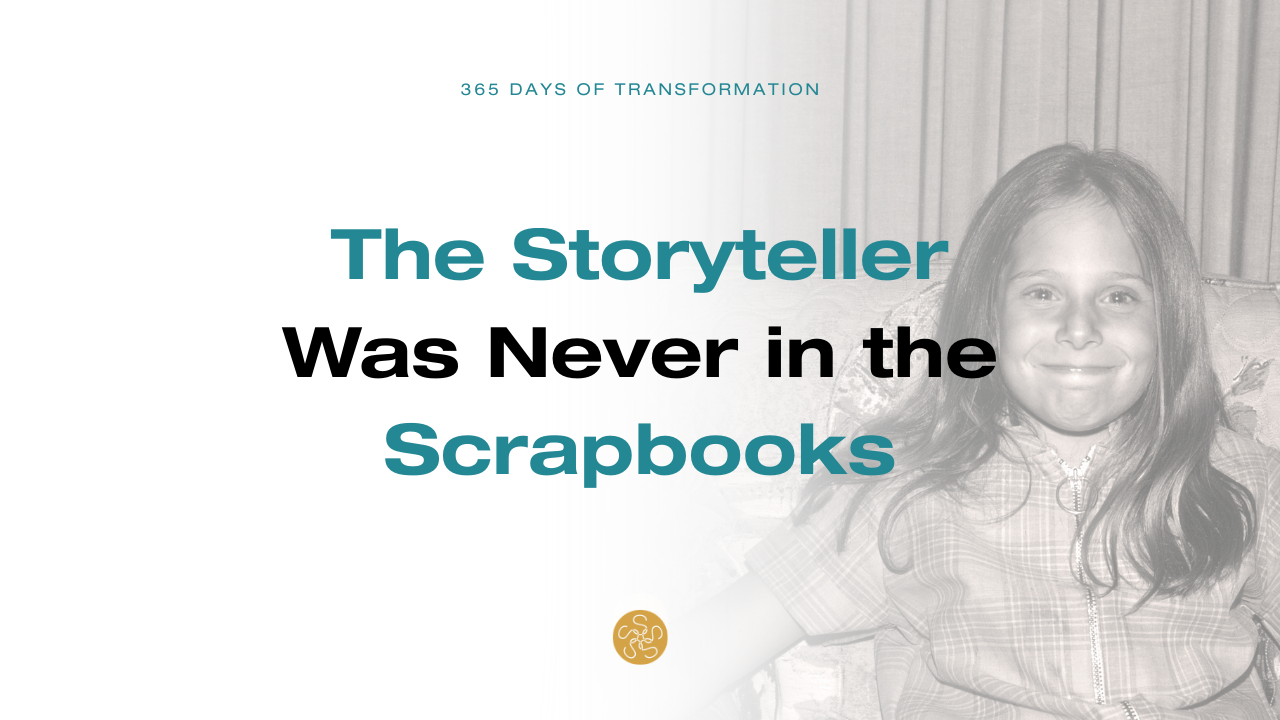
The Storyteller was never in the scrapbooks - the Storyteller is me
Everything I built, created, and saved lived in that house.
✯ The scrapbooks
✯ The cameras
✯ The photographs
The boxes of memorabilia that only a mother would think to keep. The height marks on the kitchen doorway where I scratched my sons’ names and dates as they grew taller each year.
All of it. Gone.
And sometimes in the middle of the night, usually around 2:30 a.m., when I wake up and can’t fall back asleep, I find myself replaying scenes from that life.
Not the big ones.
The small ones.
The pencil marks on the doorframe.
The stacks of scrapbook paper spread across work tables in my furniture factory while a group of women gathered on Saturdays to tell stories about our children. We called it scrapbooking. But really, we were telling the story of our lives.
After I closed the factory, the group moved to the back room of Factors Deli on Tuesday nights. We’d eat, laugh, and build those books page by page.
Those scrapbooks were beautiful. I believed they were the legacy I was leaving my children. They weren’t just photos. They were memory, design, storytelling, proof that our lives had shape and meaning.
And now they’re gone. All except two.
Even though I had organized many things in case of an emergency like this, when the moment comes, you don’t think. You just grab.
For a long time after the fire, I found myself caught in a strange tension:
How do you mourn what’s gone, without living the rest of your life in mourning?
Because grief is a strange companion, sometimes it shows up as the loss of a house. Sometimes, there is a loss of objects that hold your memories. And sometimes, if we’re honest, it’s the quiet grief of realizing you spent years longing for something you never had.
Recently, a friend and I were talking about grief and discovered we shared something unexpected. She lost her home in that same fire. And in that conversation, we recognized another layer of grief.
Part of what we were mourning was the mother we never really had. Not because she died. But because the relationship we needed never fully existed. Grief has layers like that.
But something else has happened this past year. As everything physical disappeared, something else became clearer.
The storyteller was never in the scrapbooks…
…the storyteller was me.
Those books weren’t the story, I was. And the truth is, I learned that long before the fire.
When I was twelve years old, just three days after my elementary school graduation, I landed in the hospital with collapsed lungs. It was 1973. The Watergate trials were on every television channel, all seven of them. There was a heat wave. And I was living under an oxygen tent.
But even then, I did what I’ve always done. I created. I built. I told stories.
With crayons, markers, and whatever scraps of paper my Aunt Harriet brought me, I made word searches and crossword puzzles for the nurses. Everything was hand-drawn.
Cards from visitors, notes from friends, dried flowers from bouquets that filled my hospital room, I saved them all. Eventually, they made their way into a scrapbook. Even then, I was preserving the story.
And now I’m beginning to understand something our tradition teaches as we enter the month of Adar. Adar is the month when we are told to increase joy. At first, that feels impossible. How can joy increase in a world where things burn, people disappoint us, and life doesn’t unfold the way we imagined?
But the Purim story offers a strange answer. In that story, identities are hidden. Truth unfolds slowly. What seems chaotic eventually reveals meaning. Only later do you see the pattern. Maybe that’s what this past year has been for me.
A revealing. Not just of loss. But of alignment. I’ve learned I can no longer stay in environments where I have to justify who I am, where creativity feels like something to defend rather than something to share. When I walked away from that misalignment, something unexpected happened.
My body relaxed. My mind opened. And ideas started to return. I’ve begun creating again.
✯ Art
✯ Writing
✯ Photography
I bought my first camera when I was fifteen. The lenses and bodies I collected over the years are gone now. But the eye that learned how to see through them is still here.
And maybe that’s the real lesson in all of this. We think the things we build hold our lives. But they don’t.
We do.
Right now, my life feels a little like a collage.
All the pieces I’ve gathered over decades, entrepreneurship, storytelling, community building, creativity, Jewish life, and family, are assembling themselves into something new.
A new role. A new place. A new chapter here in Colorado. And the surprising thing is…
…It feels liberating.
For the first time in a long time, I’m not trying to recreate the life that burned down. I’m creating something new from what survived. The fire didn’t end my story. It simply burned away the pages I thought I needed.
And left me holding the pen.
Maybe the scrapbooks were never the legacy I was leaving my children. Maybe the real legacy is teaching them how to tell their own stories. So perhaps that’s the real question this month of Adar invites us to consider:
What if the things you lost were never the story, only the container for it?
And if that’s true…
What new story are you ready to begin telling?
With love and creativity,
Susan
If this resonated, share it with someone who needs to read it.

THE PODCAST
Sharing personal stories of past failures and present wisdom. Here at POP, we seek curiosity, amplify the conversation, inspire action, and move the needle You can help by sharing the P.O.P. Podcast with a friend!!

Strategy, Systems + Structure
That is the first step in learning to confidently scale, automate, + monetize your ideas and business into a successful brand using the stories, skills, and experience you already have.
Schedule a Mini-Consult and let's start there!
Categories
All Categories